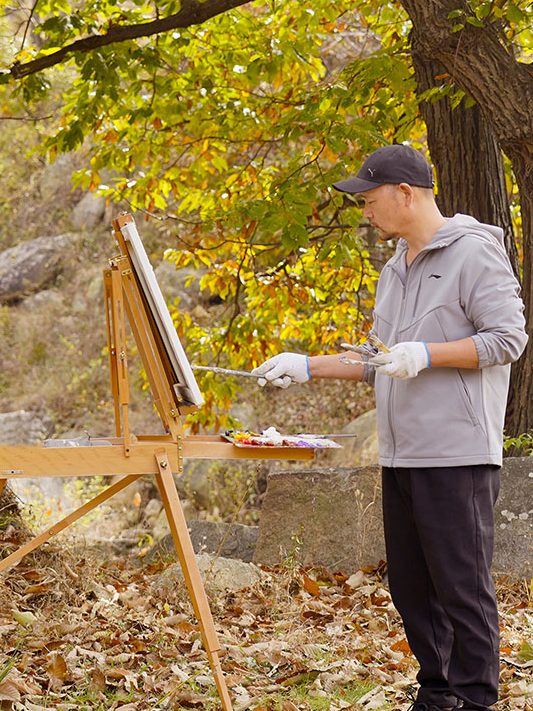
Mingliang Liu
Born in 1972 in Shandong, China, Liu Mingliang is currently a Professor at the School of Fine Arts, Qilu Normal University. He holds a Ph.D. in Art Anthropology and serves as a Director of the China Society for Anthropology of Art and a Director of the Shandong Oil Painting Society. In 2010, he graduated from the Chinese Academy of Arts under the mentorship of Professor Fang Lili, earning his doctorate in Art Anthropology.
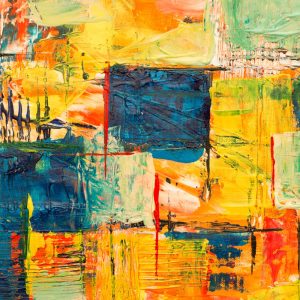
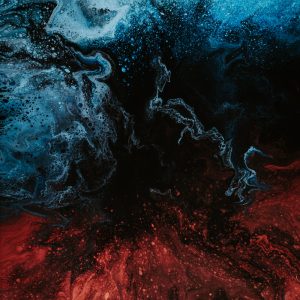
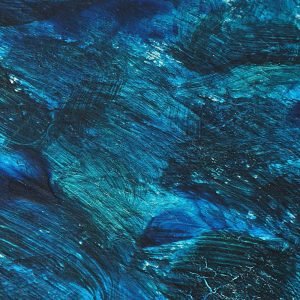
For over thirty years, Professor Liu has dedicated himself to the creation and theoretical study of Ideographic Oil Painting (Yixiang Youhua). By integrating the medium of Western oil painting with traditional Chinese philosophy, he has constructed a unique Eastern visual language that exists “between likeness and unlikeness.” He has made significant contributions to both the practical techniques and the theoretical framework of Ideographic Oil Painting.
Liu Mingliang: A Practitioner of Visual Poetry and Explorer of Art Anthropology
I. Creative Philosophy: Great Simplicity and Spiritual Solace
Traditional Chinese philosophy serves as the spiritual bedrock of Liu Mingliang’s work.
The Tao Te Ching states: “The thing that is called Tao is elusive and evasive. Evasive and elusive, yet within it there is an image. Elusive and evasive, yet within it there is a substance.” This passage perfectly captures the Eastern aesthetic in his work—neither a realistic reproduction nor a symbolic abstraction, but a capture of “elusive” beauty found between the representational and the abstract. Using Western brushwork, he seeks the subtle, indescribable charm found between the solid and the void, infusing the traditional Chinese “Spirit of Brush and Ink” (Bimo) into the medium of oil.
The Taoist principles of “Nature following its own course” and “Action through inaction” give his work an atmosphere of vivid naturalness, free from forced artifice. He allows the composition to flow effortlessly into its own structure. Inspired by the I Ching (Book of Changes) concept of “Existence and non-existence giving birth to each other,” he consistently practices “subtraction”—using the most minimalist strokes to carry the richest poetic imagery. As he puts it: “When color fades, essence emerges; the less I paint, the more the complexity is managed through simplicity.” In his works, colors become increasingly calm and elegant, yet contain a vast atmosphere within the subtle shifts of gray tones. Meanwhile, the Zen wisdom of “Self-sufficiency of nature” fuels his belief that the ultimate goal of painting is not to prove anything to the outside world, but to return to the authenticity of the inner self.
II. Artistic Journey: From Western Classical Realism to Eastern Ideographic Aesthetics
Liu Mingliang’s artistic path is a profound evolution from the surface to the core, from the tangible to the ethereal. Since beginning his career in 1988, he spent over a decade deeply immersed in Western realistic painting, gaining a thorough mastery of classical techniques and theories.
In 1999, he entered the Shandong University of the Arts for his Master’s degree, studying under Professor Mao Daizong. This was a pivotal turning point. Drawing on his familiarity with Western art history, he sensed the immense potential of combining oil media with traditional Chinese culture. He began to submerge himself in Chinese traditional culture and painting theory, integrating the “Freehand Spirit” (Xieyi), the “Charm of Brush and Ink,” and the philosophical concepts of “Harmony between Heaven and Man” into the language of oil materials. Between “likeness and unlikeness,” he found a unique path to merge oil brushwork with Eastern resonance, allowing heavy Western pigments to radiate a vivid, natural Eastern spirit.
III. Academic Depth: Theory and Practice through the Lens of Art Anthropology
Unlike purely sensory painters, Liu Mingliang possesses a rigorous academic vision. In 2007, he pursued his Ph.D. in Art Anthropology at the Chinese Academy of Arts under Professor Fang Lili. This background makes him a rare scholar-artist capable of unifying theoretical research with creative practice.
He advocates for the integration of the “Metaphysical” and the “Physical”: the depth of philosophical thought must be manifested through exquisite painterly language. He explores not only in the studio but also through academic fieldwork, publishing scholarly monographs such as Beijing 798 Art District: Fieldwork and Tracking in a Market-Oriented Context and Oil Painting Creation: Practice and Breakthrough.
It is this anthropological perspective that allows him to examine art from a higher dimension—stepping beyond the limitations of painting itself to rethink its position within the coordinates of cultural phenomena and human social development. For over thirty years, while practicing Ideographic Oil Painting, he has systematically established its theoretical framework. This anthropological lens injects his work with a unique rational light and cultural thickness—behind every brushstroke lies deep civilizational logic and rigorous thinking. He is not merely a creator of paintings, but a researcher with a complete system of thought.
IV. Artistic Reflection: A Visual Return After the Noise
In the face of today’s “concept-first” and over-interpreted art ecosystem, Liu Mingliang maintains a calm critique. He believes contemporary art is heading toward a misunderstanding: “We hear too much and see too little.” When painting is drowned by tedious interpretations, heavy concepts, and empty manifestos
when the written word overrides visual perception—art regresses.
He advocates for art to return to painting itself and to pure visual intuition. The truth of painting never lies in the packaging of language, but in the power of visual impact. Whether a work touches the heart depends not on what it “says,” but on what it allows the viewer to “see.” Through his practice, he calls for art to be liberated from the shackles of text and return to the focused, pure gaze. His paintings never attempt to explain the world; instead, they construct an ethereal space through brush and ink where the soul can settle.
V. Core Manifesto: Visual Poetry for the Eyes
In this era of information overload and frantic pace, Liu Mingliang hopes his paintings can serve as a quiet sanctuary. He defines Ideographic Oil Painting as “Visual Poetry for the Eyes”—an artistic language that requires no translation.
It transcends the barriers of geography, race, and language. Through a simple visual gaze, viewers can touch the poetic sentiment embedded in the brushstrokes and colors, feeling a cross-border emotional resonance. This visual power strikes the heart directly, transcending the limitations of words and allowing souls from any corner of the world to find a connection within the frame.
All this philosophical reflection, artistic practice, and academic exploration ultimately converge into a simple yet profound pursuit: “Great simplicity, and a place for the soul to rest.” He does not seek to explain the world; he only hopes that every viewer finds a piece of spiritual peace within his visual poetry.
Certificates